01
Recognising relationships
Explore candidates’ understanding.
A timed logical reasoning test for hiring. Every candidate answers the same questions, so you compare like with like before interview.
Try 3 sample questionsNo credit card required
Logical Reasoning KNOWLEDGE
9 of 12 questions correct
WHAT THE TEST EXPLORES
Focus on the areas that matter for the work your candidates will do.
01
Explore candidates’ understanding.
02
Compare knowledge through consistent questions.
03
Identify an area to explore in the interview.
A RANGE OF DIFFICULTY
From straightforward questions to more challenging problems.
Our Logical Reasoning test combines questions of different difficulty, helping you compare candidates across a range of abilities.
The test is labelled intermediate; the questions span a range of difficulty. Use the results alongside interviews and relevant work samples.
TESTS IN MULTIPLE LANGUAGES
Assess candidates in the language they work in.
Languages available across our test suite. Options vary by test and level.
TRY AN EXAMPLE QUESTION
Candidates preparing for a logic test can try the free example questions.
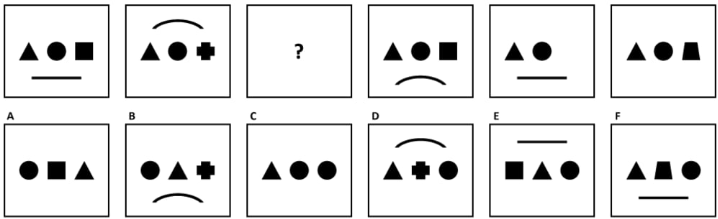
Our Logical Reasoning questions explore candidates’ understanding through a consistent format. Try an example to see the kind of information they work with.
A PRACTICAL GUIDE
Each question shows a sequence or grid of shapes with one missing. The candidate works out the rule behind it, such as rotation, count, position or shading, and chooses the shape that fits. No language, arithmetic or prior knowledge is needed, which is why it suits graduate, analyst, engineering, developer and planning roles where a new hire has to make sense of unfamiliar processes, data or systems.
Compare the percentage correct and the time taken across your candidates, then ask the strongest to explain a rule in the interview. Treat a low score as a prompt to look closer rather than a verdict: pair the test with a numerical or verbal reasoning test and a short work task, and do not use it to screen roles that are mostly known procedure, customer contact or craft skill.
Choose Logical Reasoning when candidates need to evaluate relationships and draw supported conclusions. Use Numerical Reasoning for decisions based on figures, or Verbal Reasoning for conclusions drawn from written information. Choose the combination around the information the person will use at work.
HOW THIS TEST WAS BUILT
Developed and validated by occupational psychologists and industry experts.
Group: Cognitive ability
Research for this kind of test: cognitive ability tests predict job performance at .31.
Read our methodologySEE THE RESULTS FOR YOURSELF
Explore a complete sample report, from test results and candidate comparisons to focused interview questions.
BEFORE YOU START
It explores recognising relationships, evaluating information, drawing conclusions. Use the results to compare candidates on the same questions and identify topics to explore further.
Start with the work the person will do. This page covers recognising relationships, evaluating information, drawing conclusions. Decide which of those areas matter for your role before reviewing results, and explore any specialist requirements separately.
Yes. Add Logical Reasoning alongside other relevant tests in one assessment. Choose the combination for your role and review the total time before inviting candidates.
Yes. Create your account, build an assessment and invite candidates. Your first 5 candidate results are free. No credit card is required.
You pay per candidate result you unlock, rather than per test. There is no subscription or annual commitment. Check the pricing page for current rates.
Compare results against the knowledge or ability your role needs. Use them to focus interviews and practical tasks, alongside relevant experience. A test score should not decide who you hire on its own.